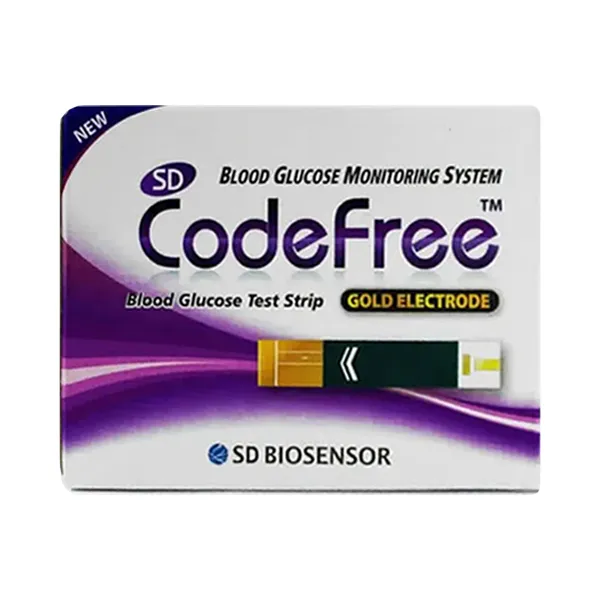
COD FREE STRIPS
Rs1,700
In stock
1
Save this product for later
Customer reviews
Reviews only from verified customers
No reviews yet. You can buy this product and be the first to leave a review.
COD FREE STRIPS
Product details
Brand: CODEFREE
Units in Pack: 50
Generic: GENERAL
Appearence / Physical Form: STRIPS
SD CodeFree Blood Glucose Test Strips – Gold Electrode Glucose Testing Strips for Accurate Blood Sugar Monitoring
Monitor blood glucose conveniently at home with SD CodeFree Blood Glucose Test Strips, specially designed for use with the SD Biosensor CodeFree Blood Glucose Monitoring System. Featuring Gold Electrode technology, glucose oxidase biosensor technology, no-coding operation, a small 0.9 µL blood sample requirement, and approximately 5-second testing, these strips are designed for convenient routine blood glucose monitoring.
SD CodeFree test strips are intended for measuring glucose in fresh capillary whole blood and are designed specifically for the SD CodeFree blood glucose meter. Their capillary-action sample application allows the blood drop to be drawn into the reaction area of the strip for measurement by the meter.
Key Benefits
✔ Gold Electrode Technology: Uses a gold electrode biosensor system designed for blood glucose measurement.
✔ Glucose Oxidase Biosensor: Uses glucose oxidase as part of the electrochemical glucose-testing system.
✔ No Coding Required: The CodeFree system is designed without manual strip coding, helping simplify the testing process.
✔ Small Blood Sample: Requires approximately 0.9 µL of blood, helping make routine testing more convenient.
✔ Fast Results: The SD CodeFree system is designed to provide a blood glucose result in approximately 5 seconds.
✔ Automatic Sample Collection: Blood is drawn into the reaction chamber through capillary action when the strip contacts the blood drop.
✔ Wide Measuring Range: The system specifications list a measurement range of approximately 10–600 mg/dL.
✔ Convenient for Routine Monitoring: Suitable for regular blood glucose testing when used correctly with the compatible meter.
✔ Designed for Home Testing: The CodeFree system is intended for blood glucose self-monitoring as well as professional use according to its instructions.
What Are SD CodeFree Blood Glucose Test Strips?
SD CodeFree Blood Glucose Test Strips are disposable in-vitro diagnostic test strips used with the SD CodeFree Blood Glucose Meter to quantitatively measure glucose in fresh capillary whole blood.
Each strip contains the reaction components required for electrochemical glucose measurement. When a blood sample reaches the strip's reaction area, glucose reacts with the strip's reagent system and generates an electrical response. The meter analyzes this response and displays the corresponding blood glucose value.
These strips are single-use medical diagnostic consumables and should not be reused.
SD CodeFree Test Strip Technology
Gold Electrode
The product packaging identifies Gold Electrode technology. The electrode forms part of the electrochemical measurement system used by the glucose meter.
Glucose Oxidase Biosensor
The CodeFree system uses a glucose oxidase (GOD) biosensor. Glucose in the blood sample participates in the reaction at the strip, producing an electrical signal that is interpreted by the meter.
No-Coding Technology
One of the convenient features of the CodeFree system is its no-coding design. Users do not need to manually enter a strip code before every test.
How SD CodeFree Test Strips Work
The testing process uses a small blood sample and electrochemical measurement:
- A fresh blood sample is obtained using a suitable lancing device.
- The CodeFree test strip is inserted into the compatible meter.
- The blood drop is applied to the designated yellow reaction area.
- Capillary action draws the blood into the reaction chamber.
- Glucose reacts with the reagent system on the strip.
- An electrical signal is generated.
- The meter measures the signal and calculates the blood glucose concentration.
- The result is displayed on the meter.
Blood Sample Requirement
SD CodeFree test strips require approximately 0.9 µL of fresh whole blood for testing according to the available system specifications. If the blood sample is insufficient, the result may not be reliable and testing should be repeated using a new strip.
How to Use SD CodeFree Blood Glucose Test Strips
Step 1 – Wash and Dry Your Hands
Wash your hands thoroughly and dry them completely before testing. Moisture, food residue, or other contaminants can interfere with blood glucose testing.
Step 2 – Prepare the Meter
Have your SD CodeFree blood glucose meter and lancing device ready.
Step 3 – Remove One Test Strip
Remove a fresh strip from its original container immediately before use. Close the container promptly to protect the remaining strips from moisture.
Step 4 – Insert the Strip
Insert the test strip into the SD CodeFree meter in the correct direction, with the contact/gold-plated side positioned as instructed by the meter manual. The meter should recognize the strip and prepare for testing.
Step 5 – Obtain a Blood Drop
Use the lancing device according to its instructions to obtain a small drop of fresh capillary blood.
Step 6 – Apply Blood
Touch the appropriate edge/yellow reaction area of the strip to the blood drop. The strip draws the blood into the reaction chamber by capillary action.
Step 7 – Wait for the Reading
Allow the meter to complete the measurement. The CodeFree system is specified to provide a result in approximately 5 seconds.
Step 8 – Dispose of the Used Strip
Remove and safely dispose of the used test strip. Do not reuse test strips.
Important Compatibility Information
SD CodeFree Blood Glucose Test Strips should be used only with the compatible SD CodeFree Blood Glucose Meter/system.
They are not universal glucose strips for every glucometer. Using an incompatible strip can result in an error message or potentially inaccurate measurements.
Before purchasing, confirm that your glucose meter is the SD CodeFree model.
SD CodeFree Test Strip Measuring Range
The available SD CodeFree system specifications indicate a measuring range of approximately:
10–600 mg/dL
This range covers a broad spectrum of blood glucose measurements, but results should always be interpreted in the context of the individual's clinical situation and the guidance provided by their healthcare professional.
For Diabetes Blood Sugar Monitoring
Regular blood glucose testing can provide useful information about glucose levels and help people and their healthcare professionals assess patterns over time.
Depending on the individual's treatment plan, testing may be performed at different times, such as:
- Before meals
- After meals
- Before or after physical activity
- When experiencing symptoms of unusually low or high blood glucose
- At other times recommended by a healthcare professional
Testing frequency should be based on the individual's diabetes management plan and medical advice.
Important Testing Precautions
✔ Check the expiry date before using the strips.
✔ Do not use strips from damaged or improperly stored packaging.
✔ Use a fresh strip for every test.
✔ Keep the test-strip container tightly closed.
✔ Protect strips from moisture and excessive humidity.
✔ Handle strips with clean, dry hands.
✔ Do not touch the reaction area unnecessarily.
✔ Do not bend, cut, or modify the strip.
✔ Do not apply blood to an area other than the designated sample area.
✔ Do not use expired strips.
✔ Do not use strips with visible damage or contamination.
✔ Keep the strips away from children.
✔ Follow the instructions supplied with the meter and test strips.
Proper Storage of SD CodeFree Test Strips
Test strips are sensitive to environmental conditions, particularly moisture. Store them according to the manufacturer's instructions and keep them in their original container with the cap securely closed.
Recommended precautions include:
- Store in a cool, dry location.
- Keep away from direct sunlight.
- Avoid excessive heat.
- Do not expose strips unnecessarily to humidity.
- Do not leave the container open.
- Remove only the strip required for immediate testing.
- Keep the original container properly closed.
Available instructions specify storage around 2°C–32°C for the referenced CodeFree strip version and advise against freezing or refrigeration. Always follow the storage information printed on your particular pack because product versions can differ.
Why Moisture Protection Is Important
Blood glucose test strips contain sensitive chemical components that participate in the glucose-testing reaction. Exposure to moisture can affect strip performance and potentially compromise test results.
For this reason:
Remove one strip → close the container immediately → perform the test.
Do not leave the vial or strip container open while preparing the blood sample.
When Should You Perform a Control Test?
A glucose control solution can be used with compatible SD Biosensor systems to check whether the meter and strips are working together properly.
A control test may be appropriate:
- When starting a new meter
- When opening a new box of strips
- If you suspect the meter or strips are not functioning correctly
- If the meter has been damaged
- After cleaning the meter
- When results appear inconsistent with expectations
The acceptable control range should be checked against the range printed on the relevant strip container or product documentation.
What Can Affect Blood Glucose Test Results?
Incorrect results can sometimes be associated with:
- Insufficient blood sample
- Incorrect strip insertion
- Expired test strips
- Damaged strips
- Improper storage
- Exposure to moisture
- Contaminated hands
- Incorrect testing technique
- Using incompatible strips
- Applying blood incorrectly
- Meter problems
If a result appears unexpectedly high or low, follow the meter's troubleshooting instructions and consider repeating the test with a fresh strip.
If results remain unusual or do not match how you feel, contact a healthcare professional rather than changing medication based solely on a single reading.
SD CodeFree Test Strips for Home Use
The SD CodeFree system is designed to support convenient blood glucose monitoring outside clinical settings. Its no-coding operation and small blood sample requirement can make routine testing simpler for people who regularly monitor glucose.
Product Specifications
Product Name: SD CodeFree Blood Glucose Test Strips
Brand: SD Biosensor
Product Category: Blood Glucose Test Strips
System: SD CodeFree Blood Glucose Monitoring System
Technology: Glucose Oxidase Biosensor
Electrode: Gold Electrode
Coding: No Coding
Blood Sample: Fresh Capillary Whole Blood
Sample Volume: Approximately 0.9 µL
Test Time: Approximately 5 seconds
Measuring Range: Approximately 10–600 mg/dL
Use: In-Vitro Diagnostic Blood Glucose Testing
Type: Single-Use Test Strip
Compatible Meter: SD CodeFree Blood Glucose Meter
Pack Size
SD CodeFree test strips are commonly supplied in 50-strip packs, including configurations such as 2 × 25 strips. However, pack quantities can vary by market or product version, so the quantity printed on your actual packaging should be treated as the final reference.
Frequently Asked Questions
What are SD CodeFree Test Strips used for?
They are used with the SD CodeFree Blood Glucose Meter to measure glucose concentration in fresh capillary whole blood.
Are SD CodeFree strips compatible with other glucometers?
They are specifically designed for the SD CodeFree Blood Glucose Monitoring System. Do not assume compatibility with another glucose meter.
Do SD CodeFree strips require coding?
No. The CodeFree system uses no-coding technology, eliminating the need for manual coding of the strips.
How much blood is required?
The specified sample volume is approximately 0.9 µL.
How quickly does the meter provide a result?
The SD CodeFree system is specified to provide a result in approximately 5 seconds.
Can I reuse a test strip?
No. Each test strip is intended for single use only. Use a new strip for every blood glucose test.
Can I use an expired test strip?
No. Do not use expired strips because their performance may no longer be reliable.
How should I store CodeFree strips?
Keep them in their original container, tightly closed, in a cool and dry environment away from moisture, excessive heat, and direct sunlight.
Why is my blood glucose result unexpected?
Several factors can affect testing, including insufficient blood, contamination, improper strip storage, expired strips, incorrect technique, or meter/strip problems. Repeat the test with a fresh strip if appropriate and seek professional advice if unusual results persist.
Are these strips suitable for diabetes monitoring?
They are designed for blood glucose monitoring and can be used as part of a diabetes-management routine according to the individual's healthcare plan.
Do I need a prescription to purchase glucose test strips?
Blood glucose test strips are diagnostic monitoring supplies rather than prescription medicines. However, users should follow appropriate medical guidance regarding glucose targets, testing frequency, and treatment decisions.
Important Medical Disclaimer
SD CodeFree Blood Glucose Test Strips are intended for blood glucose measurement and monitoring. A glucose reading is an important piece of health information, but a single reading should not be used on its own to diagnose a condition or change prescribed medication.
If you experience repeatedly abnormal readings, symptoms of very low or very high blood glucose, or readings that do not correspond with your condition, seek appropriate medical advice.
Display prices in:PKR