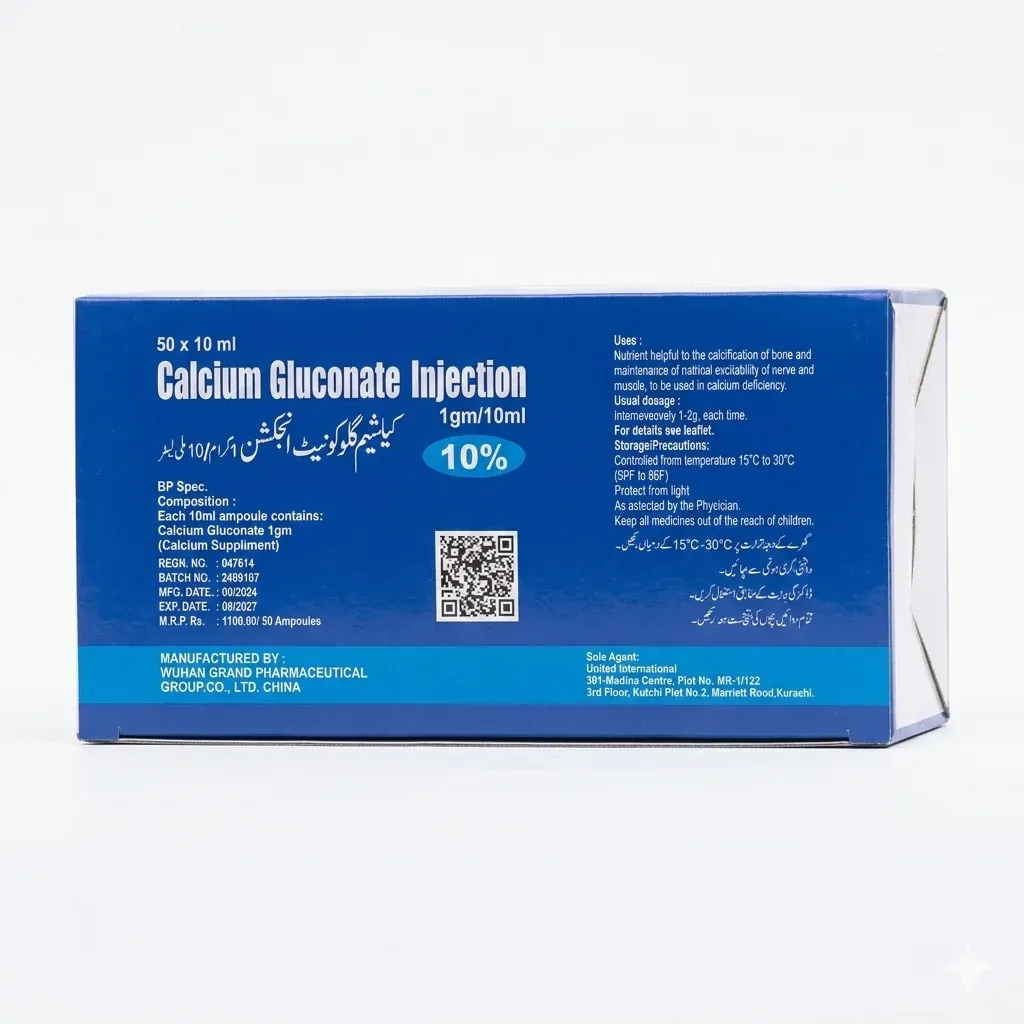
CALCIUM GLUCONATE INJECTION
Rs2,000
In stock
1
Save this product for later
Customer reviews
Reviews only from verified customers
No reviews yet. You can buy this product and be the first to leave a review.
CALCIUM GLUCONATE INJECTION
Product details
Brand: Wuhan Grand Pharmaceutical Group Co., Ltd
Units in Pack: 50
Generic: Calcium Gluconate
Appearence / Physical Form: INJECTION
Strength / Potency: 1GM
Calcium Gluconate Injection 10% w/v 10ml Ampoule – Calcium Replacement for Acute Hypocalcemia & Emergency Care
Calcium Gluconate Injection 10% w/v 10ml Ampoule is a sterile injectable calcium preparation used in clinical and hospital settings for the treatment of acute symptomatic hypocalcemia and other medical conditions where intravenous calcium replacement is required. Each 1ml contains 100mg of calcium gluconate, making the 10ml ampoule contain a total of 1g (1000mg) calcium gluconate, equivalent to approximately 93mg of elemental calcium.
Calcium is an essential mineral required for numerous vital physiological processes, including normal muscle contraction, nerve transmission, cardiac function, blood coagulation, and maintenance of normal cellular function. Injectable calcium gluconate provides calcium directly into the circulation when rapid calcium replacement is medically necessary or when oral supplementation is not appropriate.
Calcium Gluconate Injection is a prescription medicine and should be administered only by a qualified healthcare professional in an appropriate clinical setting.
Key Benefits & Clinical Uses of Calcium Gluconate Injection
✔ Rapid Calcium Replacement: Provides calcium intravenously when prompt correction of clinically significant hypocalcemia is required.
✔ Used for Acute Symptomatic Hypocalcemia: Calcium gluconate injection may be administered when low blood calcium is associated with clinically significant symptoms.
✔ Supports Normal Cardiac Function: Calcium plays an important role in normal electrical and contractile activity of the heart.
✔ Supports Normal Muscle Function: Calcium is essential for normal skeletal and smooth muscle contraction.
✔ Supports Nerve Transmission: Calcium participates in normal transmission of nerve impulses and cellular signaling.
✔ Important for Blood Coagulation: Calcium is required for several steps in the body's normal coagulation process.
✔ Useful in Selected Emergencies: Under appropriate medical supervision, intravenous calcium gluconate may be used in certain toxicological and electrolyte emergencies, including hyperkalemia-associated cardiac membrane stabilization and magnesium toxicity.
✔ Intravenous Formulation: Provides calcium through a parenteral route when oral calcium administration is unsuitable or insufficient.
What Is Calcium Gluconate Injection Used For?
Calcium Gluconate Injection is primarily used for acute calcium replacement, particularly when a patient has symptomatic or clinically significant hypocalcemia requiring intravenous therapy.
Hypocalcemia means that the concentration of calcium in the blood is abnormally low. Severe or rapidly developing hypocalcemia can affect the nervous system, muscles, and cardiovascular system and may require urgent medical treatment.
In appropriate clinical circumstances, intravenous calcium gluconate may also be used for:
1. Acute Symptomatic Hypocalcemia
Calcium gluconate can be administered intravenously when low calcium levels cause symptoms such as neuromuscular irritability, muscle spasms, tingling, or other clinically significant manifestations.
2. Hyperkalemia
In severe hyperkalemia, intravenous calcium may be used as part of emergency treatment to stabilize the cardiac membrane and reduce the risk of dangerous cardiac arrhythmias.
Importantly, calcium does not remove potassium from the body. It provides temporary cardiac membrane stabilization while definitive potassium-lowering treatment is initiated.
3. Hypermagnesemia / Magnesium Toxicity
Intravenous calcium gluconate may be used in selected cases of significant magnesium toxicity to counteract the cardiovascular and neuromuscular effects of excessive magnesium.
4. Other Clinical Situations
The use of intravenous calcium may also be considered in other specialized clinical circumstances according to the patient's laboratory results, symptoms, underlying condition, and established treatment protocols.
How Does Calcium Gluconate Work?
Calcium gluconate dissociates to provide calcium ions, which participate in numerous physiological processes.
Calcium ions are important for:
- Cardiac muscle contraction
- Skeletal muscle contraction
- Smooth muscle function
- Nerve impulse transmission
- Neurotransmitter release
- Blood coagulation
- Cellular signaling
- Maintenance of normal membrane function
When blood calcium is dangerously low, intravenous administration can increase circulating calcium more rapidly than oral calcium preparations.
In hyperkalemia, intravenous calcium helps stabilize the myocardial cell membrane, reducing the immediate risk of life-threatening cardiac electrical abnormalities. It does not lower the patient's serum potassium concentration itself.
Active Ingredient & Strength
Active Ingredient: Calcium Gluconate
Concentration: 10% w/v
Strength: 100mg calcium gluconate per 1ml
Ampoule Volume: 10ml
Total Calcium Gluconate per Ampoule: 1000mg (1g)
Approximate Elemental Calcium: 93mg per 10ml ampoule
Understanding the 10% w/v Strength
A 10% w/v calcium gluconate injection contains:
100mg calcium gluconate / ml
Therefore:
10ml × 100mg/ml = 1000mg calcium gluconate
This corresponds to approximately 93mg elemental calcium per 10ml ampoule.
This distinction is important because the amount of calcium gluconate and the amount of elemental calcium are not identical.
Calcium Gluconate Injection 10% – Product Details
Product: Calcium Gluconate Injection
Strength: 10% w/v
Active Ingredient: Calcium Gluconate
Concentration: 100mg/ml
Ampoule Size: 10ml
Total Calcium Gluconate: 1g per 10ml ampoule
Approximate Elemental Calcium: 93mg per ampoule
Dosage Form: Sterile Injection
Route: Usually intravenous when used for acute calcium replacement
Category: Calcium Replacement / Electrolyte Replacement
Clinical Setting: Hospital, emergency department, clinic, or other appropriately equipped medical facility
How Is Calcium Gluconate Injection Administered?
Calcium Gluconate Injection should be administered only by a qualified healthcare professional.
The dose, route, concentration, dilution requirements, administration rate, and duration depend on:
- The patient's calcium level
- Severity of symptoms
- Underlying cause
- Age and body weight
- Kidney function
- Cardiac status
- Other electrolyte abnormalities
- The specific clinical indication
- Other medicines being administered
For intravenous administration, calcium gluconate is generally given slowly and under appropriate monitoring, particularly when higher doses are required.
Important Administration Warning
Calcium gluconate injection should never be self-injected.
Rapid intravenous administration can cause serious cardiovascular complications, including bradycardia, hypotension, arrhythmias, and cardiac arrest.
A healthcare professional should determine the appropriate dose and administration rate.
Monitoring During Administration
Depending on the indication and severity of the patient's condition, medical professionals may monitor:
✔ Serum calcium
✔ Electrolytes
✔ Heart rate
✔ Blood pressure
✔ ECG / cardiac rhythm
✔ Kidney function
✔ Clinical signs and symptoms
Patients receiving intravenous calcium should be monitored appropriately because both the underlying electrolyte disorder and calcium administration can affect cardiovascular function.
Important Precautions
Calcium Gluconate Injection requires careful administration.
Tell the healthcare professional if the patient has:
- High blood calcium levels (hypercalcemia)
- Significant kidney disease
- Kidney stones or a history of calcium-containing stones
- Heart disease
- Cardiac rhythm abnormalities
- A history of digoxin or cardiac glycoside therapy
- Other electrolyte abnormalities
The treating clinician should review the patient's medications and laboratory results before administration.
Calcium Gluconate & Digoxin
Particular caution is required in patients receiving digoxin or other cardiac glycosides.
Intravenous calcium can increase the risk of cardiac effects in patients receiving cardiac glycosides, especially when administered rapidly or inappropriately.
The treating physician should determine whether calcium administration is appropriate and what monitoring is required.
Calcium Gluconate & Kidney Disease
Patients with impaired kidney function may have altered calcium and phosphate metabolism and may require individualized treatment.
Calcium administration should therefore be guided by laboratory results and professional assessment rather than routine self-treatment.
Calcium Gluconate Injection Side Effects
Possible adverse effects associated with intravenous calcium gluconate include:
- Injection-site irritation
- Burning or pain at the injection site
- Flushing
- Nausea
- Vomiting
- Dizziness
- Low blood pressure
- Slow heart rate
- Irregular heartbeat
Serious cardiovascular reactions may occur particularly with rapid intravenous administration.
Extravasation Risk
Calcium gluconate can cause significant tissue injury if it accidentally leaks outside the vein (extravasation).
For this reason, the injection should be administered through an appropriate intravenous access by trained medical personnel, with the injection site monitored carefully.
If extravasation is suspected, the healthcare professional should follow the appropriate institutional management protocol immediately.
Important Drug Interactions
Calcium can interact with several medicines.
Particular caution is required with:
Digoxin / Cardiac Glycosides
Intravenous calcium may increase the risk of cardiac toxicity in patients receiving cardiac glycosides.
Ceftriaxone
Calcium-containing intravenous products have important compatibility restrictions with ceftriaxone, particularly in neonates. Calcium gluconate and ceftriaxone should not be mixed or administered simultaneously through incompatible IV systems.
Healthcare professionals should follow current compatibility and administration guidance.
Other Medicines
Calcium may also affect the absorption or activity of certain medicines. The complete medication history should be reviewed before administration.
Calcium Gluconate vs Calcium Chloride
Both calcium gluconate and calcium chloride provide calcium, but they are not interchangeable milligram-for-milligram because they contain different amounts of elemental calcium.
Calcium chloride contains substantially more elemental calcium per gram than calcium gluconate.
Therefore, healthcare professionals should use the correct formulation and calculate doses based on the clinical indication and product concentration.
Do not substitute calcium chloride for calcium gluconate without appropriate medical calculation and authorization.
Why Calcium Gluconate Is Used in Hospitals
Calcium Gluconate Injection is valuable in acute medical care because it provides a parenteral source of calcium when a patient requires rapid treatment.
Unlike oral calcium tablets or syrups, intravenous calcium can increase circulating calcium more rapidly, making injectable calcium particularly useful when clinically significant hypocalcemia requires urgent intervention.
Its use in emergency medicine also includes selected situations where calcium is needed to stabilize cardiac membranes or counteract the effects of certain electrolyte toxicities.
Frequently Asked Questions (FAQs)
What is Calcium Gluconate Injection 10% used for?
It is primarily used for acute symptomatic hypocalcemia requiring intravenous calcium replacement. It may also be used in selected emergency situations such as hyperkalemia-associated cardiac membrane stabilization and magnesium toxicity.
What is the strength of Calcium Gluconate Injection?
The product specified here is 10% w/v, equivalent to 100mg calcium gluconate per ml.
How much calcium gluconate is in a 10ml ampoule?
A 10ml ampoule of 10% w/v calcium gluconate contains:
100mg/ml × 10ml = 1000mg (1g) calcium gluconate.
How much elemental calcium is in a 10ml ampoule?
A 10ml ampoule of 10% calcium gluconate contains approximately 93mg elemental calcium.
Can Calcium Gluconate Injection be given at home?
No. This is an injectable medicine intended for administration by trained healthcare professionals. It should not be self-injected.
Can calcium gluconate be given rapidly?
Intravenous calcium gluconate generally requires controlled administration. Rapid IV administration can cause serious cardiovascular effects, including hypotension, bradycardia, arrhythmias, and cardiac arrest.
Is Calcium Gluconate used for high potassium?
Yes. In severe hyperkalemia, intravenous calcium can help stabilize the cardiac membrane and reduce immediate cardiac risk. It does not directly remove potassium from the bloodstream.
Does calcium gluconate lower potassium?
No. Calcium gluconate does not lower serum potassium. It protects the heart temporarily while definitive potassium-lowering therapies are administered.
Is Calcium Gluconate the same as Calcium Chloride?
No. Both provide calcium, but their elemental-calcium concentrations differ significantly. They should not be substituted for one another without appropriate medical calculation.
Can Calcium Gluconate Injection be used during pregnancy?
Use during pregnancy should be based on a clear medical indication and professional assessment. The treating doctor should determine whether the benefits outweigh the risks.
What are the main side effects of Calcium Gluconate Injection?
Potential effects include injection-site irritation, flushing, nausea, hypotension, bradycardia, and cardiac rhythm disturbances, particularly when administered too rapidly.
Display prices in:PKR